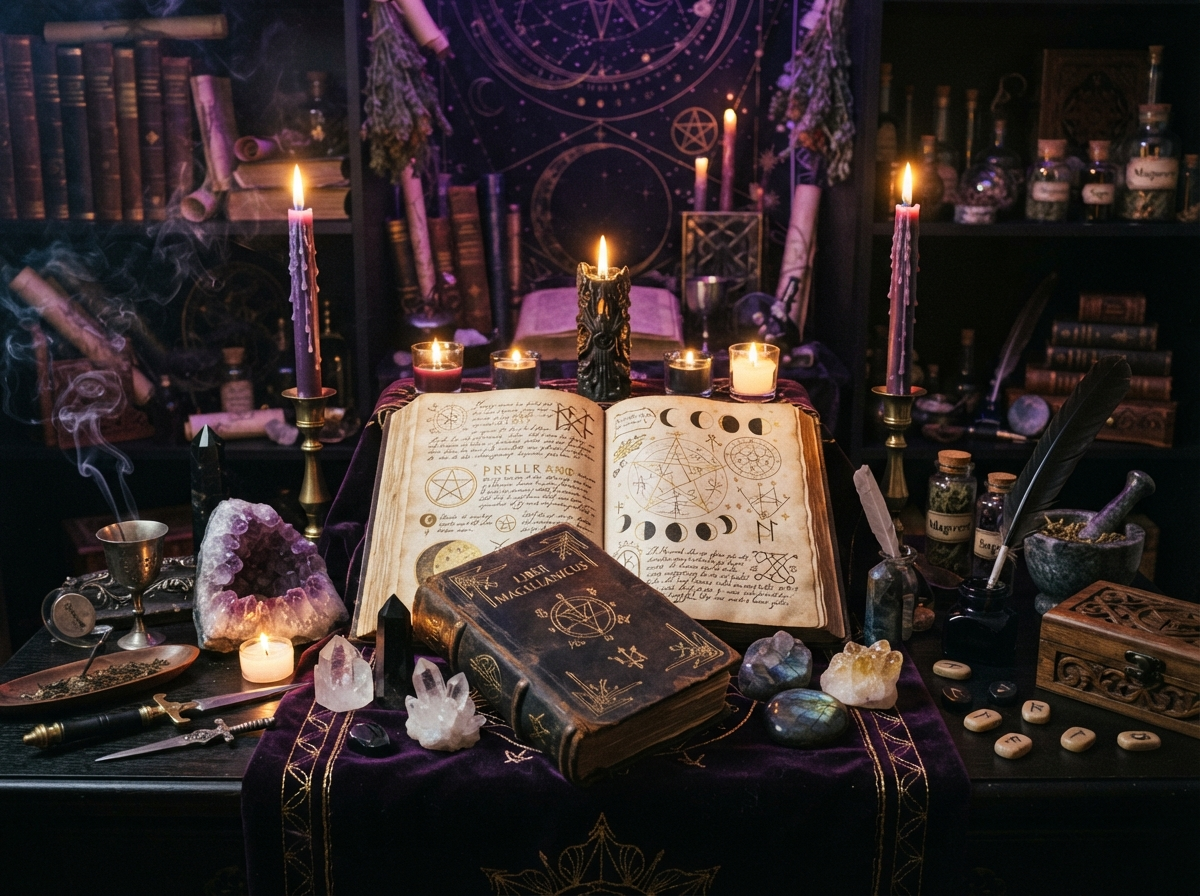
Introduction to Occult Studies: Ancient Wisdom for Modern Seekers
Explore the foundations of occult philosophy and learn how ancient esoteric traditions can enrich your spiritual practice today.
The word “occult” simply means “hidden” or “secret.”
Occult studies encompass a vast array of esoteric traditions, mystical philosophies, and magical practices developed over thousands of years.
Beyond the Stereotypes
Far from the sensationalized portrayals in popular media, serious occult study offers profound insights.
When approached with respect and dedication, occult knowledge reveals deep truths about consciousness, reality, and human potential.
What is Occultism?
Occultism is the study of hidden knowledge and mysterious phenomena. It encompasses:
- Hermetic philosophy: Ancient wisdom attributed to Hermes Trismegistus
- Kabbalah: Jewish mystical tradition exploring the nature of divinity
- Alchemy: Spiritual transformation through symbolic processes
- Ceremonial magic: Structured ritual practices for spiritual development
- Divination systems: Methods for gaining insight and guidance
- Mysticism: Direct experience of divine or ultimate reality
Historical Foundations
Ancient Egypt
The roots of Western occultism trace back to ancient Egypt.
Mystery schools there taught initiates the nature of consciousness, the afterlife, and cosmic principles.
These teachings form the foundation of much Western esoteric knowledge.
Hermeticism
The Hermetic texts are attributed to the legendary Hermes Trismegistus.
These texts form the philosophical foundation of Western esotericism.
Key principles include “As above, so below” and the seven Hermetic principles that govern all existence.
Greek Mystery Schools
Pythagorean mathematics explored sacred numbers and their cosmic significance.
Platonic philosophy developed theories about the nature of reality and the soul.
The Eleusinian mysteries provided initiatory experiences that shaped Western thought.
All of these contributed to Western occult tradition.
Medieval and Renaissance
During the Middle Ages and Renaissance, occult knowledge faced both suppression and preservation.
Scholars, alchemists, and mystics across Europe and the Islamic world protected and expanded these teachings.
This period saw the synthesis of many traditions into what became Western esotericism.
Core Concepts
The Principle of Correspondence
“As above, so below; as within, so without.”
This principle suggests that patterns repeat at all levels of reality, from the cosmic to the personal.
Understand one level and you understand them all.
The Law of Vibration
Everything in the universe vibrates at different frequencies.
Different frequencies create different manifestations of energy and matter.
Understanding vibration is central to many occult practices.
The Principle of Polarity
Everything has two aspects—opposites are identical in nature but different in degree.
Hot and cold, light and dark, masculine and feminine are all expressions of the same underlying energy.
Nothing is purely one thing or another—all opposites contain seeds of their opposite.
The Astral Plane
Many occult traditions describe subtle planes of existence beyond physical reality.
The astral plane exists between the physical and spiritual realms.
It’s associated with emotions, dreams, imagination, and non-physical entities.
The Higher Self
Most occult traditions recognize a divine spark within each person.
This higher aspect of consciousness is your connection to the divine and universal wisdom.
Spiritual development involves connecting with and integrating this higher self into daily life.
Major Occult Traditions
Hermetic Qabalah
A Western adaptation of Jewish Kabbalah exploring the nature of divinity and consciousness.
It maps reality and consciousness through the Tree of Life—a diagram of ten spheres (Sephiroth) connected by 22 paths.
This system provides a complete framework for understanding existence.
Ceremonial Magic
Structured ritual practices designed with specific magical intentions.
These practices expand consciousness, develop spiritual powers, and connect with higher realities.
The Hermetic Order of the Golden Dawn systematized much of Western ceremonial magic.
Alchemy
Often misunderstood as the pursuit of turning lead into gold.
Spiritual alchemy is actually about the transformation of consciousness.
The stages—nigredo (blackening), albedo (whitening), citrinitas (yellowing), and rubedo (reddening)—represent psychological and spiritual evolution.
Theurgy
Divine magic focused on spiritual elevation and union with the divine.
This contrasts with thaumaturgy, which is practical magic for material results.
Theurgy seeks to unite the human soul with the divine source.
Getting Started with Occult Studies
Essential Reading
Beginner-friendly:
- “The Kybalion” by Three Initiates
- “The Golden Dawn” by Israel Regardie
- “Modern Magick” by Donald Michael Kraig
Intermediate:
- “The Book of Thoth” by Aleister Crowley
- “The Mystical Qabalah” by Dion Fortune
- “Self-Initiation into the Golden Dawn” by Chic and Tabatha Cicero
Advanced:
- “The Book of the Law” by Aleister Crowley
- “The Secret Teachings of All Ages” by Manly P. Hall
Practical Steps
- Study philosophy first: Understand the theoretical framework before attempting practices
- Keep a journal: Document your studies, dreams, and experiences
- Practice meditation: Develop concentration and mental discipline
- Start with divination: Tarot or astrology provide accessible entry points
- Find a community: Study groups offer support and accountability
- Be patient: Genuine occult development takes years, not weeks
Ethics and Responsibility
Approach With Integrity
Occult knowledge carries real responsibility.
As you develop power and understanding, how you use that knowledge matters deeply.
Core Ethical Principles
Integrity — Use knowledge for positive purposes
Discernment — Not all information is accurate or helpful
Respect — Honor the traditions and their origins
Humility — There’s always more to learn
Safety — Some practices can be psychologically intense—proceed carefully
Modern Occultism
Unprecedented Access
Today’s occult practitioners have access to more information than ever before.
Online communities, digital archives, and diverse teachers make esoteric knowledge more accessible.
The Challenge of Abundance
This abundance requires careful discernment.
Quality varies widely, so develop your ability to discern truth from misinformation.
The Core Truth
The core principles remain unchanged: occult study is about personal transformation.
It’s about expanding consciousness and understanding the hidden dimensions of reality.
Transform, Don’t Collect
Remember, the goal isn’t to collect information—it’s to transform yourself.
Theory without practice is incomplete.
Practice without understanding is dangerous.
Balance study with application, and always prioritize ethical development.