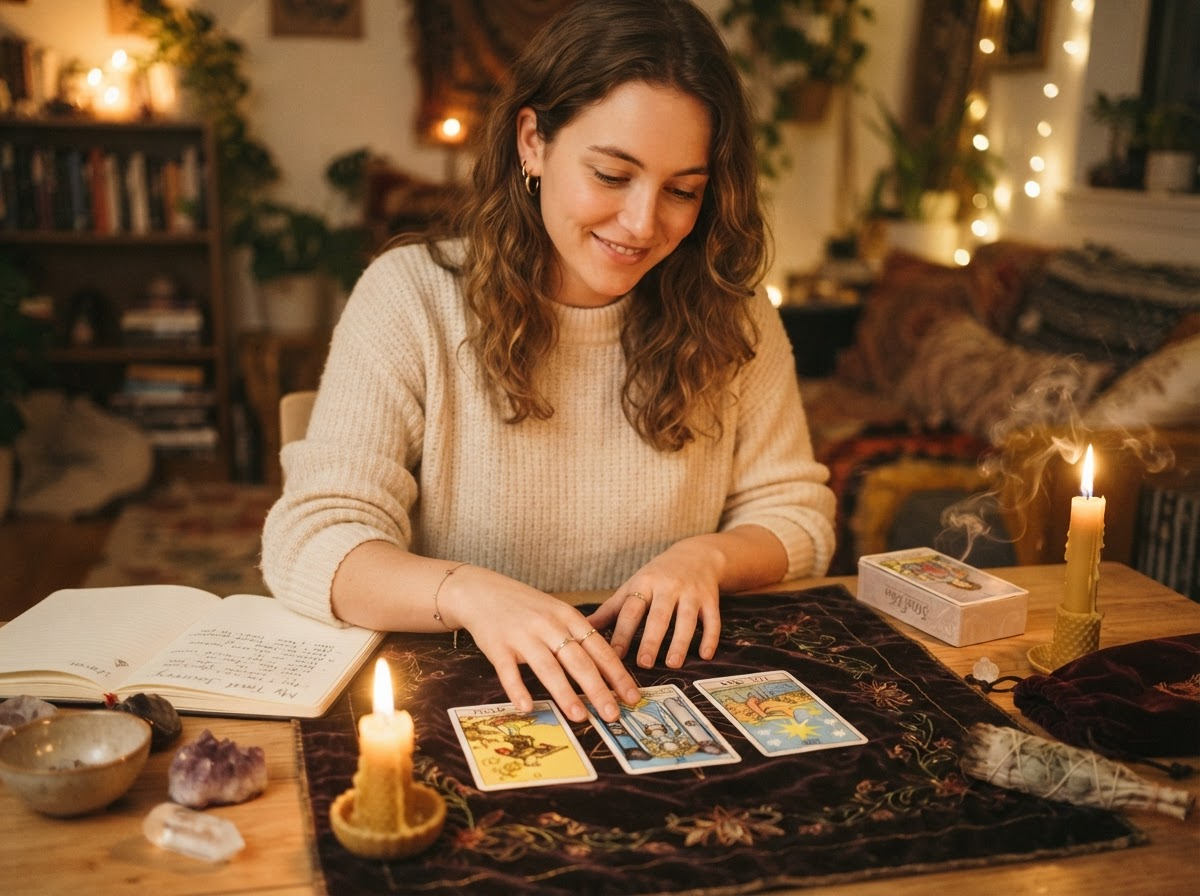
Tarot for Beginners: Your First Reading Without Fear
Learn how to give yourself your first tarot reading with confidence. This beginner's guide covers everything you need to know to start your tarot journey without intimidation or pressure.
Opening a tarot deck for the first time can feel exciting, mystifying, and intimidating.
You may be drawn to the artwork, symbolism, and mystery while quietly wondering if you’ll ever remember all 78 cards.
The Truth About Memorization
Here is the truth: you do not need to memorize the entire deck before giving yourself your first reading.
Learn Through Practice
Tarot is something you learn through practice, not theory.
Your connection with the cards develops gradually as you study their traditional meanings, notice their imagery, and discover how they speak to your intuition.
This tarot for beginners guide will help you take that first step without pressure or fear.
What Is Tarot?
A Tool for Reflection
Tarot is a system of 78 illustrated cards commonly used for reflection, spiritual exploration, storytelling, and divination.
Each card contains symbols and themes that can help you look at a situation from a different perspective.
Different Uses for Tarot
Some people use tarot as part of their spiritual practice.
Others approach it as a tool for journaling, meditation, or personal growth.
There’s no single “correct” way to use tarot.
Tarot Doesn’t Predict the Future
You do not have to believe that tarot predicts a fixed future.
The cards can instead reveal patterns, emotions, possibilities, and questions that deserve your attention.
You remain responsible for your decisions and the direction of your life.
Understanding Your Tarot Deck
The Two Main Groups
A traditional tarot deck contains two main groups of cards: the Major Arcana and the Minor Arcana.
Understanding this structure makes the deck less overwhelming.
The Major Arcana (22 cards)
These cards represent significant life lessons, transitions, challenges, and spiritual themes.
Familiar cards include The Fool, The Magician, The Lovers, Death, and The World.
The Minor Arcana (56 cards)
These cards relate more closely to everyday experiences.
They’re divided into four suits, each representing different aspects of life:
- Cups — Emotions, relationships, and intuition
- Wands — Passion, energy, creativity, and action
- Swords — Thoughts, communication, truth, and conflict
- Pentacles — Work, money, health, home, and the physical world
Trust Your Interpretation
Different tarot traditions may interpret certain symbols differently.
Your deck’s guidebook is a helpful starting point, but it is not the only voice you are allowed to hear.
Develop your own understanding over time.
Choosing Your First Tarot Deck
Start Simple
Your first deck does not have to be expensive or rare.
Choose one with artwork you can see clearly and feel comfortable studying.
The Popular Choice
Many people begin with a Rider-Waite-Smith-style deck.
Its images contain detailed symbols and many instructional books use the same system.
However, the best beginner tarot deck is one that makes you curious enough to keep returning to it.
Evaluate Before You Buy
Look at several sample cards before purchasing.
Ask yourself:
- Can I understand what is happening in the images?
- Do the colors and artwork hold my attention?
- Does the deck include a guidebook?
- Would I enjoy looking at these cards regularly?
You Don’t Need Permission
You do not need someone else to give you your first tarot deck.
Buying your own deck does not make it less meaningful or powerful.
The Pillow Ritual (Optional)
Some tarot readers follow the tradition of sleeping with a new deck beneath their pillow on the first night.
It’s believed that keeping the cards close while you sleep helps them resonate with your energy.
Make It Comfortable
This is an optional spiritual practice rather than a requirement.
If the idea appeals to you, place the deck inside its box or protective pouch before putting it beneath your pillow.
You can also keep it safely on a nightstand if that feels more comfortable.
Preparing for Your First Tarot Reading
Keep It Simple
You do not need an elaborate altar, expensive crystals, or a perfectly quiet room.
All you truly need is your deck, a question, and a few uninterrupted minutes.
Set Your Intention
Find a comfortable space and take several slow breaths.
Hold your cards and decide what you want the reading to help you explore.
Ask Better Questions
For your first reading, avoid questions that demand a simple yes-or-no answer.
Open-ended questions usually provide more room for insight.
Good Starter Questions
- What energy should I pay attention to today?
- What do I need to understand about my current situation?
- What is one helpful step I can take?
- What lesson am I being invited to explore?
Shuffle Your Way
Once you have chosen your question, shuffle the cards in whatever way feels comfortable.
There is no single correct shuffling method.
You can shuffle them like playing cards, mix them gently on a table, or divide the deck into smaller piles.
Stop when you feel ready.
Try a One-Card Tarot Reading
Perfect for Beginners
A one-card reading is one of the best tarot practices for beginners.
It allows you to concentrate on a single image without becoming overwhelmed.
Draw and Observe
Draw one card and place it face up in front of you.
Before opening the guidebook, spend a moment examining the card.
Notice what catches your attention first.
Ask Yourself These Questions
- What people, objects, colors, or symbols appear in the image?
- What emotion does the card create?
- Does the image feel active, still, welcoming, tense, or uncertain?
- How might the card connect with the question I asked?
Write down your first impressions.
There are no wrong observations during this part of the exercise.
Compare With Traditional Meaning
Next, read the traditional meaning in your deck’s guidebook.
Compare it with what you noticed.
You may discover your first impression closely matches the traditional meaning.
You may also notice something personal that the guidebook doesn’t mention.
Both forms of information can contribute to your interpretation.
You Do Not Have to Memorize Every Card
Let Go of Perfectionism
One of the most common worries among tarot beginners is the belief that they must immediately memorize all 78 cards, including their reversed meanings.
You do not.
Learn Gradually
Start by learning a few basic keywords for each card.
As you continue practicing, the meanings will become more familiar.
You will also begin recognizing repeating symbols, numbers, colors, and patterns across the deck.
Use Your Guidebook
It is completely acceptable to consult your guidebook during a reading.
Using a reference does not make the reading less genuine.
It simply means you are still learning—and every experienced reader was once a beginner.
Take Your Time With Reversals
You may also decide not to use reversed cards immediately.
Learn the upright meanings first.
Introduce reversals later if they support your reading style.
Keep a Tarot Journal
Track Your Growth
A tarot journal helps you see how your understanding develops over time.
Over weeks and months, you’ll notice patterns and progress.
What to Record
For each one-card reading, record:
- The date
- Your question
- The card you selected
- Your first visual impression
- The traditional meaning
- Your personal interpretation
- What happened or became clearer afterward
Weekly Practice
Try pulling one card each morning or evening for a week.
At the end of the week, review your notes.
Look for repeated cards, suits, emotions, and lessons.
The Real Purpose
The purpose is not to prove whether every reading was “right.”
The purpose is to strengthen your observation, reflection, and relationship with the cards.
What If You Pull a Frightening Card?
Don’t Panic
Cards such as Death, The Devil, or The Tower can be alarming when you first encounter them.
However, dramatic imagery does not automatically predict disaster.
Their Real Meanings
Death frequently represents endings, release, or transformation.
The Tower may indicate disruption, revelation, or the collapse of something unstable.
The Devil can point toward unhealthy attachments, temptation, limitation, or patterns that need to be recognized.
Think Before You React
Pause before assuming the worst.
Consider the question you asked, the card’s symbolic meaning, and the choices available to you.
When to Reach Out
Tarot should not leave you feeling powerless.
If a reading creates intense anxiety, put the cards away, return to the present moment, and speak with someone you trust.
Begin With Curiosity
Your First Reading
Your first tarot reading does not need to be perfect, dramatic, or psychic.
It simply needs to begin.
The Simple Practice
Draw one card. Look carefully. Write down what you notice.
Read the traditional meaning and consider how it applies to your question.
That small practice is enough.
From Test to Conversation
Tarot becomes less intimidating when you stop treating it like a test and begin treating it like a conversation.
Stay curious, remain patient with yourself, and allow your understanding to grow one card at a time.
Tarot readings are intended for spiritual exploration, personal reflection, and entertainment. They should not replace professional medical, legal, mental-health, or financial guidance.